This page is specifically for Indian nationals; other nationalities go through a different visa and fee process. It covers what applies once you're at the border: documents, the entry permit, SDF, whether you need a guide or an agent, and practical basics like money and mobile network. For how to physically get to Jaigaon and find the crossing, see Directions. If you're bringing your own or a rented vehicle, see the vehicle entry guide instead.
On this page
Do you need a travel agent?
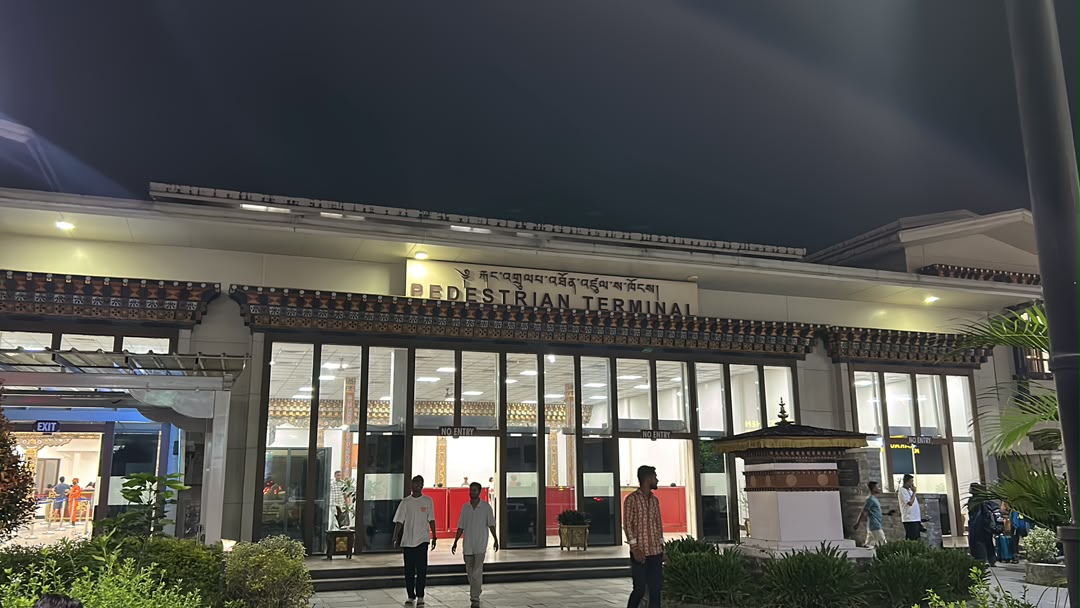
No. Indian travellers coming on their own do not need a travel agent to enter Bhutan. You can cross at the Pedestrian Terminal and complete your documentation at the Immigration Office yourself, without going through an agent or any middleman.
A travel agent is only useful if you want the convenience of having your hotel, guide or transport arranged for you. It isn't required for crossing the border or getting your entry permit. For a full, step-by-step account of what this looks like in person, see the home page guide.
Bhutan immigration
Crossing through the Pedestrian Terminal gets you inside Bhutan, into Phuentsholing. If you're travelling beyond Phuentsholing, you then walk further in to the Immigration Office, where your Entry Permit is processed.
Inside the terminal you'll also see a tourism office counter, but that one is only for tourists who have already applied for their permit online in advance. You can apply online yourself at the Department of Immigration's official portal, immi.gov.bt.
| Requirement | Detail | |
|---|---|---|
| Visa | Not required for Indian nationals | Official |
| Travel document | Original passport (min. 6 months validity) OR original Voter ID card | Official |
| Minors | Birth certificate (in English) or passport, accompanied by a legal guardian | Official |
| Entry Permit | Issued at the Immigration Office based on your documents, or applied for in advance at immi.gov.bt (for travel beyond the border town) | Official |
Carry originals, not photocopies. This is the single most common cause of delay at the counter.
Department of Tourism / tourism information
Bhutan's Tourism Council sets the policies covering guide requirements, certified accommodation, and the official registry of licensed guides and tour operators. A separate online tourism services portal handles entry-permit-related services for independent travellers arranging their own trip.
A government tourism office is not the same thing as a private travel shop, even if a shop's signage uses similar language. To confirm a hotel is officially certified, or that someone offering guide services actually holds a licence, check the Tourism Council's own registry rather than taking their word for it.
Do Indians need a guide?
Yes. A guide is mandatory for every tourist visiting Bhutan, everywhere in the country, including Thimphu and Paro. There is no exemption for staying within these two towns, and this applies to every nationality, not just Indian travellers.
A guide can be arranged directly, as a licensed individual, or through a tour operator. Note that Bhutan's published "Minimum Daily Package," which bundles a guide into a set nightly rate, applies to the general international-tourist regime, not to Indian nationals. Indian nationals instead pay the Sustainable Development Fee described below, and arrange a guide separately.
Sustainable Development Fee (SDF)
The SDF is a nightly fee that funds environmental and cultural conservation programmes. The rules differ depending on whether you're staying within the border town or travelling further in.
Border-town day visit vs. travelling further
- Day visit only, within 24 hours, to Phuentsholing, Samtse, Gelephu or Samdrup Jongkhar: no SDF and no Entry Permit required.
- Staying overnight, or travelling beyond the border town: an Entry Permit is required, and SDF applies at INR 1,200 per adult, per night.
| Category | SDF (per night) |
|---|---|
| Adult (Indian national) | INR 1,200 |
| Children aged 6–12 | INR 600 (50% concession) |
| Children aged 5 and under | Exempt |
| Day visit only, border town, ≤24 hours | Not applicable |
How SDF is paid
SDF is collected in cash only, in Indian Rupees. Cards are not accepted for this payment. Notes need to be in clean condition: no stains, tears or heavy wrinkles. Worn-out or old notes can be rejected at the counter, so carry a few crisp, newer notes set aside for this payment.
If you extend your stay, SDF continues to accrue for each additional night. If your trip is cancelled or cut short, SDF is refundable through the Department of Immigration. Confirm the current process for extensions and refunds locally, since procedural details like this can change.
What happens after immigration
Once you're through, you're in Phuentsholing, a walkable town with hotels, shops and banks. From there, onward travel typically continues by road:
| Destination | Approx. distance | Approx. travel time |
|---|---|---|
| Thimphu | ~170 km | ~5–6 hours |
| Paro | ~150–170 km | ~4–5 hours |
| Punakha | ~200+ km | ~6–7 hours |
These are rough estimates only; mountain roads, weather and traffic all affect actual travel time. Travel onward from Phuentsholing is by tourist vehicle, arranged privately or through your guide/operator. Public buses and shared vehicles are not how tourists travel this route, so arrange transport ahead of time rather than expecting to find something on arrival.
Money
Bhutan's currency is the Ngultrum (BTN), pegged 1:1 with the Indian Rupee.
- Indian Rupee is widely accepted across Bhutan.
- ₹500 notes may not be accepted everywhere, particularly in smaller towns. Smaller denominations are more reliably accepted.
- UPI works in parts of Bhutan through the Bhutan QR network, but acceptance is inconsistent across hotels, restaurants and shops. Don't rely on it as your only payment method.
- Indian cards and ATM access are unreliable outside the main towns. Carry enough cash for your trip rather than relying on withdrawing or paying digitally.
Mobile network and internet
Indian SIM cards (Jio, Airtel, Vi) generally only work in a small radius around the border. Further inside Bhutan they're unreliable, and expensive if international roaming is enabled.
Bhutan has two mobile operators: Bhutan Telecom (state-run) and TashiCell (private). A tourist SIM is inexpensive, commonly cited around Nu 210 including some talk-time and roughly 1 GB of 4G data, valid for about a month. You can usually buy one with a copy of your passport or ID. Wi-Fi is generally available in hotels in the main towns, but less reliable in remote areas.
Common mistakes at Jaigaon
These are avoidable planning mistakes, not scams:
- Arriving without original documents (photocopies aren't accepted at the counter).
- Assuming Jaigaon and Phuentsholing are the same place, or that "crossing the gate" is the whole process.
- Confusing a private travel shop with an actual government office.
- Paying for a service before understanding exactly what it includes.
- Assuming the first person who offers help represents the government.
- Relying on an old blog post instead of checking current requirements, this page included. Verify anything time-sensitive before you travel.
- Not knowing the difference between the vehicle Bhutan Gate and the Pedestrian Terminal.
- Not planning onward transportation from Phuentsholing in advance during peak season.
- Carrying only ₹500 notes, or notes that are torn, stained or heavily worn. These may be refused, especially for SDF payment.
Cost breakdown
There is no single fixed price for this trip. Costs vary by season, vehicle type and personal choices. Use this as a planning framework:
| Item | Approximate range |
|---|---|
| Bagdogra Airport → Jaigaon (taxi) | Varies by vehicle type and season |
| Hasimara → Jaigaon (auto-rickshaw) | Low, short local fare |
| SDF, per adult per night (beyond border town) | INR 1,200 |
| SDF, child aged 6–12 | INR 600 |
| Bhutanese tourist SIM card | ~Nu 210 |
| Green Tax (self-driving beyond Rinchending — see the vehicle guide) | Nu 4,500 per day |
| Accommodation | Varies widely by town and category |
| Guide (mandatory everywhere in Bhutan) | Varies by operator and duration |
| Food | Varies by choice of restaurant |
Treat these as a framework for budgeting, not a quote. Prices shift with season, demand and vehicle/room category.
This page is a practical guide for Indian travellers crossing at Jaigaon–Phuentsholing. Always check current official information before you travel.